Kentucky Derby / Churchill Downs History
Kentucky may have been an unusual place for the start of something as big as the Kentucky Derby has become going into 2014, but using a little horse-sense, it becomes quickly apparent that it took a visionary such as Colonel M. Lewis Clark to set the pace.
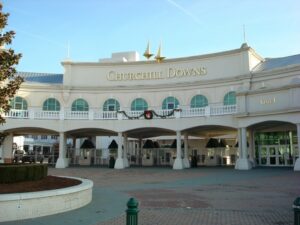
Prior to building Churchill Downs, horse racing in Kentucky had a rich racing history dating back to 1789 when the first race course was laid out in Lexington. Even before this date, folks were “road horse racing” down Louisville’s Market Street and Lexington’s Main Street in 1783. It took nearly 100 more years, until 1875, that Churchill Downs officially opened and began the tradition as we know it of being the “Home of the Kentucky Derby.”
To finance the construction of the track, Clark raised $32,000 by selling 320 exclusive memberships to the track at $100 each. Eighty acres of land, about three miles south of downtown Louisville were leased from Clark’s uncles, John and Henry Churchill. A clubhouse, grandstand, porter’s lodge, and six stables were built on the site for the opening of the track that they called Churchill Downs.

The track’s debut took place on May 17, 1875 with only four races scheduled; the feature race being the Kentucky Derby. The winner of the first ever race at the track was named Bonaventure, however the winner of the day’s featured race was a three-year-old colt called Aristides. Owned by H.P. McGrath, Aristides was trained and ridden by two African-Americans, Ansel Williamson and Oliver Lewis. All their respective names have gone down in history.
Thanks to the efforts of Colonel Clark and his uncles, and men like E. Berry Wall, also known as “The King of the Dudes” for being so dapper, and who presented roses to the ladies at the fancy post race parties, that the Kentucky Derby also became known as the “Run for the Roses”. To continue the theme of roses, it was in 1896 that a blanket of roses was first placed onto the back of the Derby winner. The rose is the official flower of the Derby and winning still smells sweet!
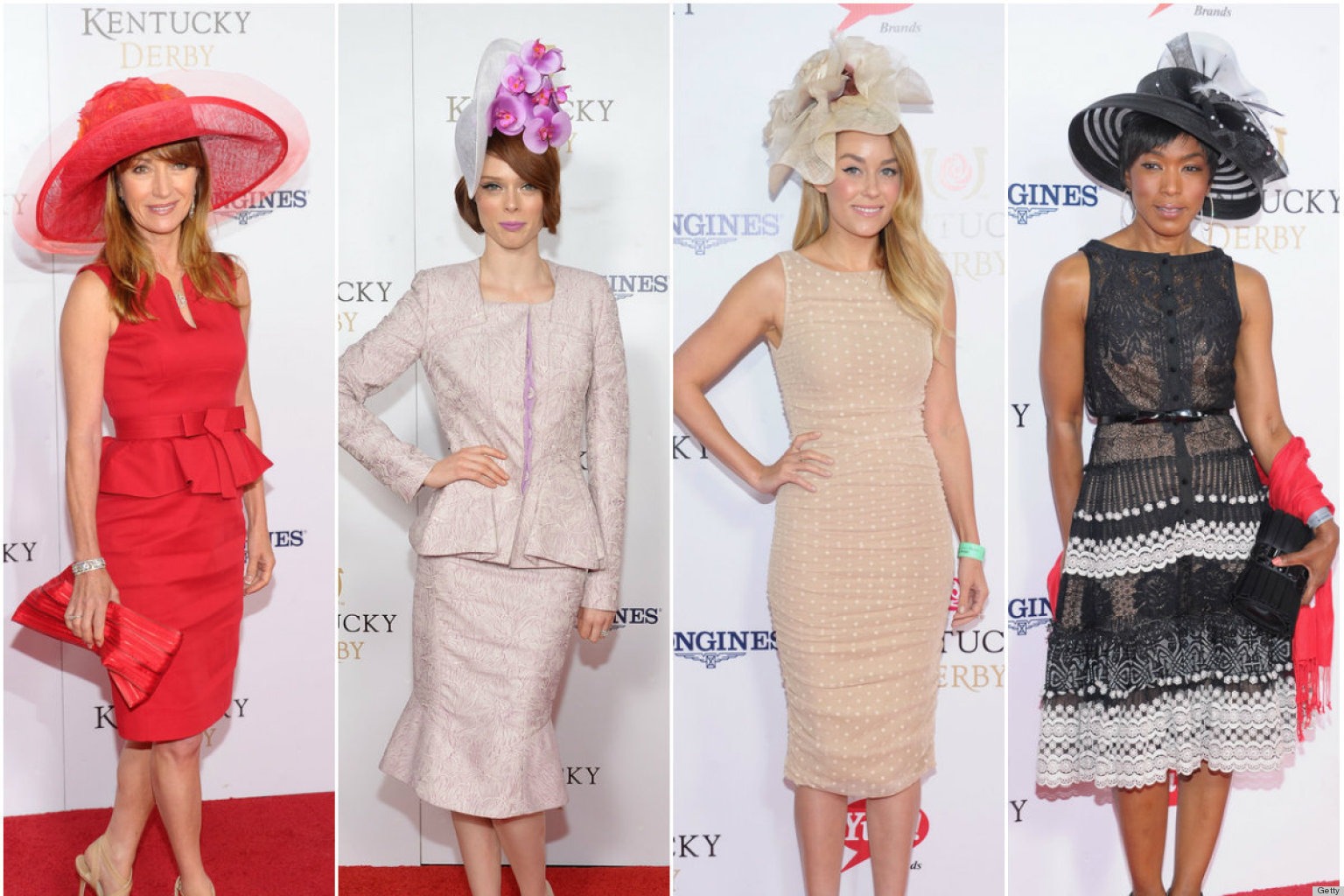
From big ugly hats, to even crazier dresses, the Kentucky Derby has some of the most interesting customs of any major sporting event and we are in for a treat when we watch Kentucky Derby 2014.
It isn’t just the ladies that put on hats on opening day of the Kentucky Derby that takes place on the first Saturday in May each year at Churchill Downs in Louisville, Kentucky. Men seem to be just as eager to show of their derby day spirit even though men’s hats are not the elaborate versions that women wear. A little history about hats however, is in order to understand why we do what we do every year in May.
The derby hat or bowler, as it is commonly known, was originally a stiff hat in form, due to the shellac applied to make the head covering strong in order to protect one’s head. Today, they are much more flexible and fit the head more comfortably. There are no designs on it and are simply black in color. Way back when, bowler hats were worn at the Epson Derby in England. England is not only the place where a lot of American history began, but also the place where the history of the Kentucky Derby began. We Yanks named our derby after the Epson Derby because after all, the 12th Earl of Derby began the whole thing about horse racing derbies and the wearing of hats in 1780.
Today, 2014, ladies hats at the Kentucky Derby tend to be eccentric, over-the-top, or supremely elegant. What it is not is boring to be there on opening day to see the feathers, flowers, festoons, and other hat adornments that are even ridiculous in some cases.
Originally at the turn of the century, umbrellas were banned from being carried into the derby areas since derby watchers needed a clear view to see the track. Imagine then, with unpredictable weather and fashion colliding – voilà – we get the remarkable phenomenon of derby day hats. It keeps the rain off the curls and the sun out of the eyes and adds to the pizzazz, vitality, and glamour that we know as opening day of the world famous Kentucky Derby.
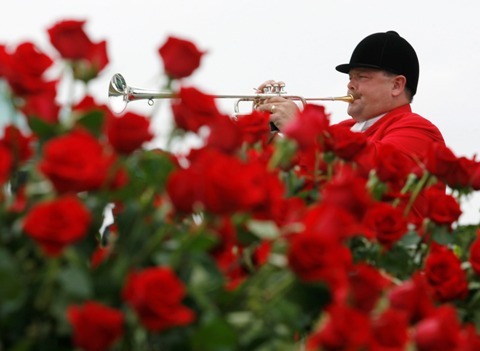
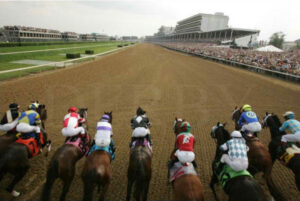
On Derby Day, Steve Buttleman arrives between 7:20 and 7:30 and as the official Churchill Downs bugler, he works every race at the track. On Derby Day he is for fifteen seconds a year, the most famous man in America. On the first Saturday of every May, he emerges from the white pagoda behind the Churchill Downs Winner’s Circle, lifts a polished brass horn to his face, and plays “Call to the Post.” This is the call that tells the jockeys to lead their mounts into the starting gate and brings thrills to every person holding a ticket both at the track and watching at home.
Buttleman does not start blowing the famous tune if he sees bucking or a horse acting erratically. He does not want to make it worse…for the horse that is.
Most people ask him whether or not he gets nervous knowing there are millions of folks watching and listening to him, but he is a cool character and has been in love with the bugle for a long time. In fact, he has been the official bugler for 18 years now at the Kentucky Derby.
In addition to that famous race, Churchill Downs holds two annual sessions: the Spring Meet from April to June and the Fall Meet from September to November. Races are held five days a week, and Buttleman has been known to play “Call to Post” up to eleven times a day.
Lest you think that Steve Buttleman is a slouch, let it be known that he earned a music degree from the University of Louisville, raised two children while his wife became a pediatric doctor and is an ambassador of the Kentucky Derby and travels to various places to represent his adopted state – he’s from Iowa originally. All the while he carries his bugle with him and plays a few bars of that famous Kentucky Derby 2014 tune.
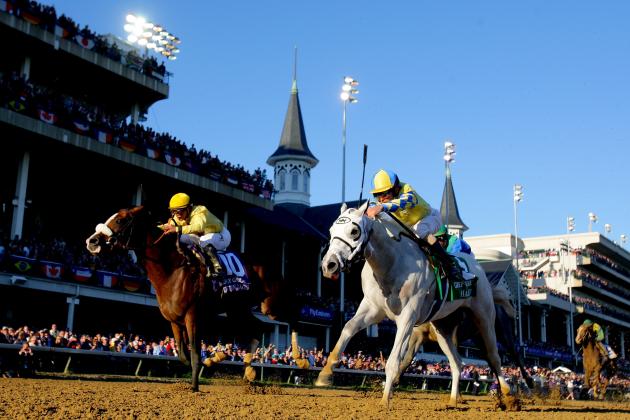
As horse lovers and Kentucky Derby goers know – its all about the horse. Well, almost anyway since what the horse eats is also a determining factor on winning and losing the derby. A quick lesson on bluegrass will help you understand the nature of horse racing as well. The history of the Kentucky Derby has taught us a couple of things; one is that the race is the most exciting 2 minutes in sports, and secondly it is usually a star studded event.
First, bluegrass is really not blue and it is not only the classification of banjo music. Real Kentucky bluegrass is a beautiful dark green grass with broad tipped leaves that grows about 18 to 24 inches tall. The other thing about this grass is that thoroughbreds thrive on it. Bluegrass grows especially well in Kentucky and other southern states because of the climate and because of the lime content of the soil that creates this rich nourishing grass. Lime raises the pH of soil and makes it “sweet” as the horse breeders say.
Turf grasses will not grow well in highly acid soils and many a gardener has had to add lime to balance out the soil condition. Luckily for some parts of Kentucky, it all comes naturally. The bluegrass region of the state generally is situated in central Kentucky – right around Lexington and just south of Churchill Downs. That’s where the famous breeding farms of Kentucky such as Calumet Farms and Hill ‘n’ Dale are located. By the way, Hill ‘n’ Dale Farms is also the final resting place for the legendary racehorse and stallion Seattle Slew, winner of the 1977 Triple Crown and leading sire of such horses as A.P. Indy, Slew o’ Gold, Landaluce, and many other offspring.
Each horse breeding farm is more picturesque than the other and if you want your fill of “horses, hooch, and history” as they say, and perhaps get a tip or two for the next Kentucky Derby winner, visit Kentucky soon. You won’t regret it.
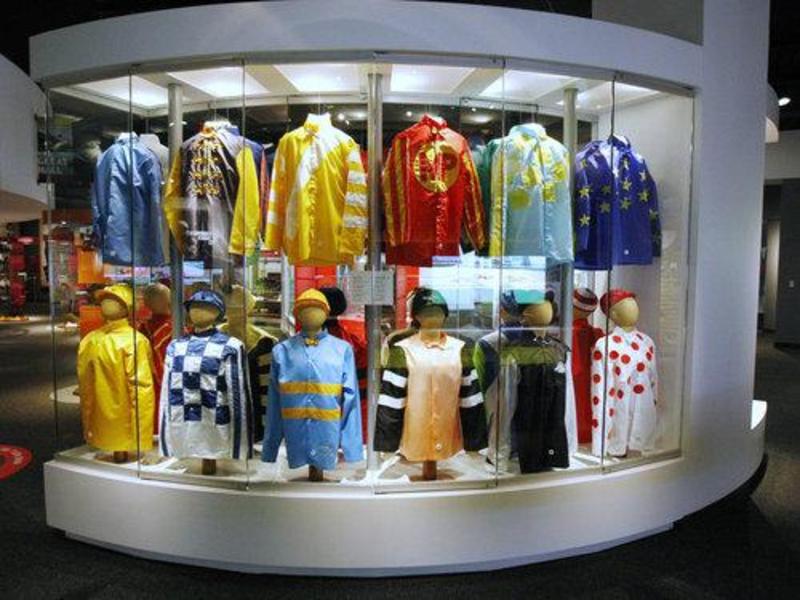
The Kentucky Derby has significantly evolved over recent years and in today’s history lesson we will be taking a look back at Kentucky Derby racing silks as we ready ourselves for the 2014 Kentucky Derby.
Horse racing silks date back to nearly 1750 and were first introduced in England. Due to the lack of programs, television monitors and other devices to tell one jockey from another, it was critical for judges to recognize who won a race. Over the years it became a requirement for each horse owner to register their colors and patterns (silks) which also had to pass muster with The Jockey Club before horses were allowed to race in the United States. Originally, all the jackets or shirts were made of silk fabric but today they are made of synthetic fibers.
Several of the more iconic silks that have been successful at the Kentucky Derby are from the Meadow, Howard, and Whitney Stables. Meadow’s blue and white blocks, blue sleeves and white stripes were on Secretariat’s jockey and also on the famous Riva Ridge. “The greatest sight in racing,” according to Penny Chenery, who raced Riva Ridge and Secretariat, “is seeing a horse, with your silks on, coming down the stretch on the lead.” A set of Secretariat’s silks is still on display at the school where Christopher Chenery, Penny’s father and founder of Meadow Farm, studied engineering and graduated in 1909.
The Howard Stable sported a red, white triangle and “H,” white sleeves. Howard’s horses Seabiscuit, Kayak II, and Noor were the most famous. In 2003, three sets of the silks worn by George Woolf when he rode Seabiscuit were auctioned off for $1,700, $1,100, and $1,000.
The famous Sonny Whitney Stables’ jockeys wore an Eton blue jacket and brown cap. As the story goes, in 1898 the Earl of Durham’s horses had lost him a great deal of money, but his silks were among the oldest in English racing and William Whitney, Sonny’s grandfather, coveted them. He asked the earl for his price. “You can have them,” the earl said. “They’ve been of no luck to me.”
The silks found their way to the U.S. Harry Payne Whitney, Sonny Whitney’s father, bred and raced Regret, the first filly to win the Kentucky Derby.
The 140th running of the Kentucky Derby is still three months away but it is never too early to look ahead for the big race. On Saturday, May 3rd, 2014 live from Churchill Downs in Louisville, Kentucky, we will see the 140th annual road to the roses race, Kentucky Derby 2014. To help you get in on all the action we are going to help you place your Kentucky Derby wagers over the Internet.
Interestingly, all horses celebrate their birthdays on January 1, regardless of the actual date of their births. This means that two year olds race only against other two year olds, three year olds only compete the first half of the year and then ratchet up to challenge other older horses once they have a few races under their belts. The Kentucky Derby is run solely by three year old horses.
The purpose of knowing the above information, is so that you will be able to make an objective decision on which horse to bet on. Knowing the age and experience of a horse will tell you a lot about their capacity for running in a race. At most racetracks the first thing you should do is get a program. Check out the names and numbers of the horses and jockey names. Also, buy yourself a newspaper called the Daily Racing Form. Once you become initiated in how to read all about past performances for every horse- and there are easy to follow instructions- you’ll be ready to go to a betting window.
A minimum bet consists of $2.00. You can pick a horse to win, place, or show – meaning that you are betting that the horse you pick should come in first, second, or third place. A safe bet for a novice bettor is to buy a Show ticket on a horse since you will win regardless if your horse comes in first, second, or third place. Be aware that to maximize your winnings, you should bet $6.00 on a horse. This is called betting across the board and you will receive money for your Win, Place, and Show ticket should your horse come in a winner.
There are many other more sophisticated wagers called Trifectas, Quinellas, Exactas, Pick Six, and Daily Doubles. Major payoffs can be achieved with a minimum bet of $1.00 or $2.00, but unless you have supreme beginner’s luck, the wise course is to know your horses and their track records.
Horse betting superstitions are like any other thing in life; when you’re winning they make perfect sense, but when you lose they are stupid so keep that mind with your Kentucky Derby 2014 picks and predictions.
One of the most famous superstitions at the racetrack is peanuts are bad luck. That’s why they do not sell them at any track or so they say. Maybe the ballpark concessionaire has a corner on the market. As a kid, I remember several horsemen of my father’s era saying that gray horses and horses with four white feet are considered unlucky in racing. Of course, we know that doesn’t always hold true. Also, there are trainers who habitually avoid the color red; they say it’s bad luck. Here is a little old English horse-buying proverb to coincide with this theme of superstition:
One white foot, buy him.
Two white feet, try him.
Three white feet, be on the sly.
Four white feet, pass him by.
This idea came about because some horsemen thought white hooves were more brittle and prone to injury than black ones. As far as I know, there hasn’t been any research on this nor has there been a higher number of break downs of gray horses or white legged ones for that matter..
Perhaps the superstitions came about because horse racing and gambling is so uncertain that horsemen and bettors want something they feel that they can control. Sort of like rubbing your favorite slot machine before you insert any money, or wearing your favorite tie or ring. And, if at the track and your horse should win, be sure to park in the same area next time!
Then there is the story of the race trainer Sam Hildreth, a man who put great faith in his dreams, especially when betting. One night, Hildreth dreamed of a large hat. The next day he scanned the entries for a horse with the word “hat” in his name. He found two, Hatrick and Top Hat. As luck would have it, both horses were entered in the same race, so Hildreth bet on both horses to win.
Hatrick and Top Hat ran nose-to-nose, well in front of the field for almost the entire race. But just when it looked as though they were going to finish first and second, another horse came flying down the stretch to snatch victory away from the two “hat”-in-the-name horses.
The name of that winner was Sombrero.
Update: To view our latest Super Bowl online betting picks and predictions update check out our latest update here and get in the know for Super Bowl 2015.
Well, we are a couple of months away from the Kentucky Derby but we still have something to look forward to and bet on while we wait. Super Bowl 2014 is upon us and will kickoff Sunday, February 2nd, 2014 at MetLife Stadium in East Rutherford, New Jersey, home of the New York Giants and Jets.
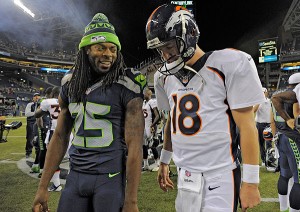
Except on this Sunday’s game there will not be any team from New York playing but will feature Giant’s quarterback Eli Manning’s brother, Peyton. Peyton Manning and the Denver Broncos knocked out the New England Patriots in the AFC conference game and secured their place in Super Bowl 2014. The teams for Superbowl 48 have been set and now you may start your Super Bowl online betting for the big game in a couple of weeks time.
From the NFC championship game we saw the Seattle Seahawks defeat the San Francisco 49ers which means it will be a Broncos Seahawks matchup for Superbowl 48.
If you are sick of people on Facebook going back and forth on who has done what in the NFL, and who’s going to win Super Bowl 2014 then listen up here because we actual have some information that will be of help. This will be Peyton Manning’s second Super Bowl appearance, and Wes Welker’s 3rd. That’s 5 Super Bowls between the two whereas the Seahawks have 0. Sure, Russell Wilson, Richard Sherman, and Marshawn Lynch, are great players for the Seattle Seahawks however they simply lack big game experience. Most online sports betting sites have the Broncos as -1 point favorites for Super Bowl 2014 and we think the betting odds should be more like -7 points. If you want to bet on Super Bowl 48 then take the Broncos on the point spread.
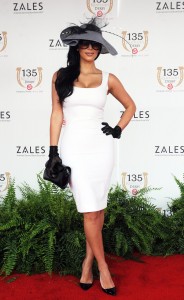
The Kentucky Derby has always been a star studded affair and the 2014 Kentucky Derby promises to not disappoint as far as celebrity sightings at the Kentucky Derby go. Past celebrities to attend the Kentucky Derby have included NBA player Dwayne Wade of the Miami Heat, and celebrity Kim Kardashian who we don’t quite know how to label her.
The Earl of Derby came to the Kentucky Derby in 1930. The Duke of Windsor came in 1951. Other royalty has come and gone, decked out in big hats, big wallets, and big titles. But the Derby has been host to just one Duke.
Known as the “Duke” John Wayne’s all-American movie celebrity made him the logical and patriotic choice for the 1976 Derby, when the country was in the midst of Bicentennial celebrations. Wayne was grand marshal of the Pegasus Parade, one of the largest parades in the U.S. begun in 1935, that kicks off the Kentucky Derby Festival two weeks before the first Saturday in May, when the Derby is held.
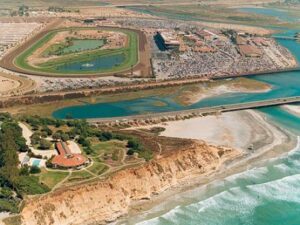
The “Duke” reserved the 25th floor of the Galt House, the official Kentucky Derby hotel in Louisville where he shunned the drink of locals… bourbon, for his personal favorite – tequila. Wayne relished his privacy and hated crowds which is why he only accepted the Pegasus as one of the few parades he would grand marshal. Wayne was a racing fan from way back and could also be seen at the Del Mar Racetrack often.
The first president to attend the Derby was Harry Truman and followed by 25 other U.S. presidents that have attended the Derby but only one as a sitting president and that was Richard Nixon. Nixon attended in 1968 when he was a candidate running for office of president as a guest of then Governor, Louie Nunn. He promised Governor Nunn that should he win, he would return. Sure enough, the following year, Nixon came back to witness the Derby as president. At least some presidents keep political promises they make.
It may be an undeniable fact that Del Mar Race Track may have a once in a lifetime opportunity to become the Saratoga of the West. It may also rise to its former glory back in the day when Bing Crosby crooned his way through the racing calendar. The reason for all the hope and glory is that Hollywood Park is set to close the end of this year. Sad but true that the relentless march of progress and business pressures takes its toll. But yet, one man’s ceiling is another man’s floor which is something to keep in mind as we head towards Kentucky Derby 2014.
Joe Harper ought to know. He has been the chief executive at Del Mar for the last 35 years and is the grandson of Cecil B. DeMille a Hollywood icon of all icons. If his lineage speaks of anything it is pageantry and class with a good bit of elegance thrown in. Del Mar is one of the few racetracks left still feeling the glamor.
The Hollywood connection is a huge part of the history of Del Mar. Younger readers may not know who the stars were but they still know class when they see it – both in the horses and people who come dressed to the nines. It’s not the shorts and T-shirt crowd. In fact having lunch at the Del Mar Turf Club still requires semi formal dress.
When Crosby first organized the Del Mar Turf Club in 1937, the executive board included Joe E. Brown, Pat O’Brien, Charles Howard, Oliver Hardy, and Gary Cooper. The mega stars of the day like Jimmy Durante, W.C. Fields, Mickey Rooney, Ronald Reagan, and Ava Gardner would come down from Los Angeles, followed by their groupies who wanted to catch a glimpse of the rich and famous. “There’s a smile on every face, and a winner in each race,” Crosby sings, “where the turf meets the surf at Del Mar.” He personally greeted each racing fan on opening day.
One year after the gates at Del Mar opened, the famous Seabiscuit vs. Ligaroti race was held where Seabiscuit won by a nose with a much heavier rider on his back. By 1940 the Del Mar slogan became “Where the Turf Meets the Surf.” It is a beautiful track and the hope is that it will remain so for many racing seasons to come.